

Pass the exam.
Nail the calculation.
Free, both of them.
Drill NEC quizzes, run 52 code-accurate calculators, and log your apprentice hours. Every answer cites the 2026 article and the 2023 article it replaced, so it holds whichever edition your AHJ enforces.
No signup, no paywall, no metered tables.
Drill the code until the answer is reflex.
Practice sets by article, by state and by exam type. Every answer explains itself with the code reference, so you learn the book while you drill instead of memorising a key.
A 25 hp, 460 V, three-phase squirrel-cage motor is protected by an inverse-time breaker. What is the maximum standard breaker size at 250%?
Electricians and EEE students already study with us.
“An outstanding app for mastering the NEC Code! It offers precise study materials, a wide range of practice exams, and detailed feedback. Perfect for journeyman and master electricians!”
“Used the app for studying for my electrical exam. It’s harder than the real exam but helped me pass the Ohio test. The tricky wording actually made me understand the code better.”
“Awesome tool to build confidence for the journeyman exam. The questions pulled from your state are a huge bonus. Highly recommend!”
52 calculators. Two code editions. One answer you can defend.
Load calcs, conductors and conduit, grounding and bonding, motors and transformers, solar and storage — every result printed with dual citations.
Three apps. The truck, the exam, the logbook.
Android & iOS · free
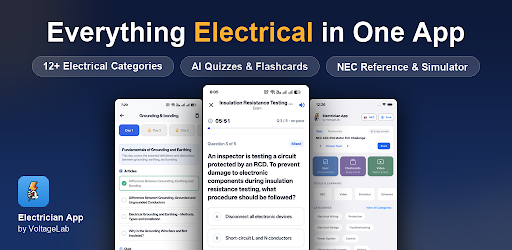
Electrical & Electrician App
On the truckThe calculators, tables and conversions you reach for between pulls. Speak the inputs, get the answer with its citation, and keep working with no signal.
- /Wire size, voltage drop, conduit fill, box fill
- /NEC tables and NEMA configuration lookups
- /Voice entry, fully offline, no ads

VoltageLab: NEC Exam Prep
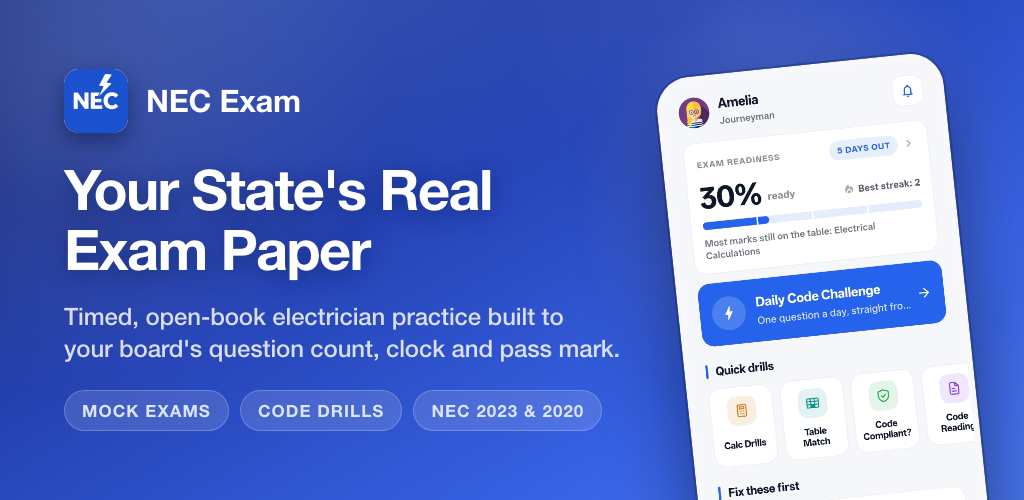
For the licensing examJourneyman, master and contractor practice on the 2026 and 2023 editions, with the article printed on every answer.
- /Thousands of questions, timed or by article
- /Explanations that cite the code, not just the key
- /See which articles keep costing you marks

Electrician Apprentice Hours
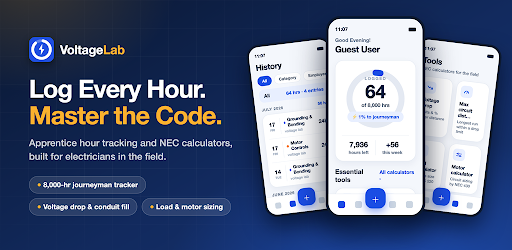
For apprenticesLog OJT hours in seconds, watch the journeyman total climb, and hand your board a record you can defend — with six NEC calculators built in.
- /Presets or start–end entry, tagged by category
- /Employers and supervising licences on file
- /Exportable history, works fully offline
Written by people who work the code
All guides →Put the whole code book in your pocket.
Quizzes, calculators, flashcards and apprentice hours. No subscription, no trial, nothing behind a paywall.